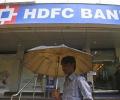
After the latest rout, the American depositary receipt (ADR) premium of HDFC Bank to its local shares has shrunk to nearly zero. Shares of HDFC Bank on Thursday fell 3.1 per cent to Rs 1,490, extending its two-day decline to 11 per cent. Meanwhile, the ADR has slumped over 15 per cent in the past two trading sessions.

As much as Rs 47,810 crore was spent on share buybacks by 48 companies in 2023 -- the highest amount since 2017. This surge in value was largely driven by a few large-sized issues, including those by Tata Consultancy Services (Rs 17,000 crore), Larsen & Toubro (Rs 10,000 crore), and Wipro (Rs 12,000 crore). In 2022, 58 companies had repurchased shares worth Rs 38,305 crore, according to data from Prime Database.

Hospital chain Aster DM Healthcare's plans to sell its Gulf business may run into rough weather with voting advisory firm Institutional Investor Advisory Services (IiAS) raising concerns over the transaction. Recommending an 'against' vote on the resolution, IiAS has said there is no clarity on how Aster DM will utilise the proceeds that it will obtain by selling the unit, which contributes to bulk of its revenues. In November, Aster DM had announced its plans to sell its wholly-owned subsidiary Affinity Holdings, which conducts business in the Gulf Cooperation Council (GCC) region, to Alpha GCC for $1 billion.

Foreign portfolio investors (FPIs) pumped in Rs 1.7 trillion into domestic stocks in 2023, one of the highest net inflows ever witnessed during a calendar year, of which 25 per cent went into the direct buying of stocks. Data provided by depository NSDL revealed that Rs 44,950 crore of the total FPI flows last year went into primary issuances. A large portion of the FPI investments through the stock exchange route went into block deals, thereby reducing the actual investments made via direct buying of stocks. Last year saw selldowns or block deals worth Rs 2 trillion.

Only the top 5 per cent profit makers account for 75 per cent of profits.

Eleven companies have launched their initial public offerings (IPOs) in December 2023, making this month the second-best December for public offerings since 1996. Collectively, they are raising Rs 8,182.7 crore this month. In December 2021, 11 companies raised Rs 9,534 crore. However, excluding December 2021, this month marks the best December for IPOs since 1996.

The benchmark Nifty and Sensex could see another 8-10 per cent from the current levels, said HDFC Securities in its outlook for equity markets in 2024. The brokerage said that the market movement in the next year will not be linear, and there will be more volatility. When asked about the market reaction to the General Elections in 2024, Dhiraj Relli, managing director and CEO of HDFC Securities, said more than the outcome of the elections, the market movement in the next three to four months will decide the market trajectory post elections.

A combination of strong earnings and economic growth, and hopes of the Federal Reserve ending the rate-hike cycle have pushed gross buying of Indian equities by foreign portfolio investors (IPO) to a new high. In 2023, FPIs have been gross buyers of shares worth Rs 25.5 trillion, the highest ever in a calendar year. FPIs also sold shares worth Rs 23.9 trillion. On a net basis, they were net buyers to the tune of Rs 1.6 trillion, the highest since 2020.

Going 'long' is becoming an overcrowded trade on Dalal Street, and any negative trigger could lead to a sharp correction, warn experts. However, given the strong momentum, particularly in IT stocks, the downside could be protected in the immediate term. "With the Nifty50 surging to new life-time highs, the bulls remain in control. Further upsides are likely once the immediate resistance of 21,492 is taken out.

The gap between market capitalisation of Hong Kong and India has dwindled significantly. At present, India's market cap stands at approximately $4.3 trillion, while Hong Kong's is around $4.7 trillion. In the depths of the Covid-19 crisis in March 2020, Hong Kong's market cap, at $4.6 trillion, was 3.44 times larger than India's.

More than half a dozen companies will hit the market with their initial public offerings (IPOs) between now and the end of next week. The cumulative amount raised from these IPOs is expected to be around Rs 8,000 crore. Stationery products firm DOMS Industries and home financier India Shelter Finance's IPOs - of Rs 1,200 crore each - got off to a flying start on Wednesday (December 13), with the former garnering over six times the subscription and the latter getting 1.5 times subscribed.
'The deal pipeline across products is robust for 2024.'

Fundraising through qualified institutional placement (QIP) has revived this year, led by commercial banks, after a lacklustre 2022. According to data compiled by Prime Database, Indian companies have raised Rs 53,070 crore in 2023 so far, of which seven banks - Union Bank of India, Indian Bank, Bank of India, Federal Bank, IDFC First Bank, Bank of Maharashtra, and J&K Bank - account for Rs 21,290 crore, or about 40 per cent. If other financial institutions are included, the figure surges to Rs 26,690 crore.

After a sharp rally in the equities market this year, investors could be better off rotating some funds towards the debt market. Experts believe several tailwinds could spur bond market returns over the next 12-18 months. These include India's robust macroeconomics, declining inflation, and the imminent passive flows of close to Rs 2.5 trillion on account of domestic sovereign bonds getting included in the JP Morgan global indices.

Global private equity (PE) firms are successfully offloading large equity stakes in domestic companies in the open market, taking advantage of buoyant conditions. Strong domestic liquidity support and an upward trending market have underpinned over a dozen PE exits worth $2.5 billion, data compiled by Business Standard shows. The figures exclude PE exits during maiden share sales and shares sold by strategic investors, such as SoftBank and Ant Group in new-age companies.

The National Stock Exchange (NSE) of India is going to indefinitely defer the internal deadline set for extending trading hours, according to sources in the know. The exchange aimed to introduce a three-hour evening session exclusively for index derivatives by March 2024, contingent upon regulatory clearance from the Securities and Exchange Board of India (Sebi). Sources indicate that the market regulator has not provided a favourable indication, dimming optimism surrounding the proposal.

'A key reason for the strong interest in IPOs has been an increased focus on profitability and reasonable pricing of deals.'

The domestic equity markets are expected to extend gains following the strong showing of the Narendra Modi-led Bharatiya Janata Party (BJP) in the state elections - a crucial precursor to the general elections in May. The BJP decisively secured victories in three of the four key states - Madhya Pradesh, Rajasthan, and Chhattisgarh. While the battles in these three states were closely contested, the scale of the BJP's triumph has surprised many, heightening expectations for regime continuity in 2024 - a positive catalyst for the markets.

Higher valuation creation in companies beyond the top 100 has given the domestic markets a shot at a $4 trillion market capitalisation (mcap) - a club exclusive to three countries currently. On November 23, the mcap of all BSE-listed stocks finished at a new record of Rs 328.33 trillion ($3.94 trillion), despite the benchmark indices ending with losses. The mcap was propelled by gains in the broader market, including small and midcap stocks - a trend dominant this year.

The Federal Retirement Thrift Investment Board's (FRTIB), one of the US government's main retirement funds, decision to change the benchmark index for gaining international exposure will channel $3.6 billion (Rs 30,000 crore) inflows into domestic equities. India has a weightage of 5.3 per cent, seventh-most in the new MSCI ACWI IMI ex USA ex China ex Hong Index, which FRTIB now plans to use. India isn't part of the current developed markets-dominated MSCI EAFE index that the pension fund uses.
 © 2026 Rediff.com - Investor Information - Advertise with us - Disclaimer - Privacy Policy - Sitemap - Feedback - About us - Terms of use - Grievances